













POV: Interview with Lynn Teo, Chief Experience Officer
Welcome to The Agency Post! Tell us a little about yourself.
I’m Lynn Teo, Chief Experience Officer (CXO) of McCann. I’ve been a practitioner and leader of the experience design domain for over 15 years. After graduating from Carnegie Mellon University, I began my career in product/interface design at Bell Communications Research – in an interesting division called RapidApps that served as a consulting arm and rapid-prototyping lab for clients. It was there that I honed my skills in research-based product/interface design and learned the craft of creating useful, intuitive, highly-functional yet simple UIs. I weathered the dot-com bust in the Early Aughts (and stayed gainfully employed, thankfully), then ported my skills to other industry verticals in the consulting and agency world. My experience spans working with clients in media and publishing, lifestyle, beauty, luxury travel and fashion, financial services, retail banking and CPG. After taking on several dual-role posts (Creative Director and Director of Experience Design), my sphere of responsibility expanded to include leadership of global teams and heading up UX Centers of Excellence. It’s been amazing being a part of this growing discipline, shaping its evolution as the technology landscape advances.
Your new role as the Chief Experience Officer at McCann Erickson was just announced. McCann has a rich legacy of producing amazing creative campaigns, but its work has been more focused on traditional advertising mediums. How will your new position help to build upon this legacy?
Creative campaigns are a critical communications platform for brands to connect, entice and engage. McCann’s legacy has always been rooted in storytelling and that will always be a treasured aspect of our heritage – it’s what makes our delivery of the message compelling, memorable and unique.
In my new position, I draw inspiration from McCann’s “Truth Well Told” credo as a catalyst to brand transformation. Experience design is about designing with purpose, empathy and consideration for the user. It comes from a deep understanding of people, their needs, motivations, triggers and emotions in a holistic way. Regardless of the type of experience delivered – a mobile app, website, tablet, interactive displays or in-store physical experience (I consider store layouts, service staff and checkout kiosks part of the experience), experience designers must first determine the behavioral drivers, potential pathways that are taken and the cycle of interactions encountered with a brand, product or service.
Once this overarching blueprint of the experience is understood, experience designers then shift their focus to seeking points of innovation, and then deliver on those enhanced or new experiences by translating those needs into thoughtful, intuitive, useful and enjoyable moments. Experience designers are true collaborators at heart and relentless seekers of “truth.” They have an embedded “empathy gene” and are masters at understanding the narrative of the consumer’s journey. They are also designers and builders – information architects, UX designers or hybrid UX-content strategists by trade who are skilled at translating their understanding of people into tangible products and services. The legacy of McCann could not be better embraced and advanced by introducing experience design as a core discipline to bring a fresh take on marketing and advertising. Experience design at McCann will partner closely with the strategy and creative domains, complementing and elevating the richness of interactions brands have with consumers.
How do you plan to build your team to best address the needs of McCann’s clients?
I am combing the ends of the earth for the very best talent in the industry. But the mix of skills and backgrounds is going to be an alchemy. Every agency needs to find the right balance and blend of experience design skills and personalities to make things work for them and their clients. I have a game plan for my dream-team and am looking to make key hires in the next few months. Collaboration and an innate curiosity are two key personality traits I look for.
How will you continue to collaborate with others in the industry in your new role at McCann?
I plan to stay active in the NYC chapters of the IxDA, UPA and offline UX meetups. Most recently, I was a founding member of the Service Design Network (SDN), the first U.S.-incorporated chapter. I’m proud of the fact that NYC was SDN’s first North American chapter!
Something I hope to be able to devote time to later this year is to help establish a platform for experience designers who work in advertising and marketing agencies. My path to experience design originated from a design, technology and engineering background – unlike most of my counterparts in advertising, who came here with a communications, fine arts, visual design or creative (art direction or copywriting) background. The experience design domain is not well understood, and it is sometimes misunderstood. To further this discipline, we need to bring disparate approaches to the table and develop a unique point-of-view on how experience design is best applied in the advertising and marketing industry. Traditional creative and experience design can coexist, but it must come from a mutual understanding and respect for each other’s craft.
What do you feel has been lacking in the integration of traditional and digital advertising initiatives?
One of the biggest missed opportunities, in my opinion, is brand experiences that fail to prolong the momentum and brand awareness once a campaign ceases. The life of a creative campaign can sometimes be extended if it evolves to serve as a platform for further consumer engagement that delivers lasting value for a consumer. Utilities are one way to ensure continued engagement with the brand, where the focus shifts back to the user on what’s relevant, engaging and ultimately a value-add. Other examples are loyalty programs or social/community management programs that allow brands to continue engaging with consumers in a targeted way. The use of data is a key point of integration in bringing together traditional and digital advertising initiatives, as are measurement, analytics and feedback loops from digital channels that can inform and enhance traditional initiatives.
What’s your definition of experience design? How should a user experience division interact with, augment or lead other disciplines?
I love that question, as it’s always a conversation starter at parties! My definition of experience design is that it’s a practice that seeks to understand what users need, then takes those insights into a carefully considered process to shape products or services. “Products” is a general term I use to refer to any object where there is a “human+” interaction. Early references to products tended to be “human-computer” interfaces. But I’ve coined the term “human+” because some interfaces are invisible – such as interactive voice prompt (IVR) and some are physical – the retail storefront experience for instance. The UX discipline needs to expand into the realm of experience design (ExD) so that all facets of the consumer’s brand touch points are considered. Additionally, service design is gaining ground a sister-discipline to experience design as its focus is on changing or introducing innovations in the larger ecosystem in which these product experiences live.
UX teams should work in tandem with strategy, creative and technology teams (creative technologists and developers). Experience design (ExD) teams, on the other hand, have a broader remit and should be part of conversations with business and account leads, product managers, strategists and creative. Experience designers are “T-shaped” leaders who have honed their core design skills in disciplines such as user research, user interface design, interaction design, industrial design or information architecture. These hybrid thinkers possess tremendous empathy for other digital disciplines and traditional marketing practices, making them ideal ambassadors for cultural change and new thinking.
How does user experience differentiate itself from other areas, such as information architecture and UI? Or are these roles all part of the overarching field of user experience?
User experience has become the overarching term that houses sub-disciplines. Information architecture tends to be the term used when the product is a content-heavy website or feature-heavy application. The breadth of complexity in interfaces varies widely – some are informational, task-driven or transactional, while others are highly experiential (containing lots of visual elements, motion, transitions, on-screen dynamic interactivity) and designed to encourage browsing. The design of touchscreen applications for tablets or smartphones requires knowledge not only of the content that sits on it, but also the form factor of the device (screen size, designing for touch, etc.). My take is to put less emphasis on titles, but more on the skill set requirements of the “thing you’re building” and the content you’re going to deliver on it. Again, it all goes back to purpose, intent and context as the starting point.
What is your process for approaching a project from a user experience point of view? How do you begin to understand how the brand or message should be interpreted or reacted to?
I always recommend that team members do three things. First, talk to users. Second, get acquainted with secondary research about the industry or category, focusing on competitors. Third, map out the journey of the user – identify key phases, then overlay with user pain points, frustrations and workarounds.
Regarding the first step, there are different levels of investment you can make in this – some entail partnerships with the strategy or planning team. You can interview individuals who represent target segments or personas, or cast a wide net to assess trends through questionnaire responses. This can then be followed by focus groups to probe on the “why” behind trends and responses. The methodologies I favor most are in-context observations and ethnography. These techniques are time and resource-intensive, but I have learned over the years that they provide the best insights into opportunities for innovation. Most importantly, they bring the designer closer to the consumer and his or her context of use. Ideas that emerge from this understanding bring a new perspective to consumer insights that inspire the creation of deeper, more immersive and meaningful brand experiences.
In my opinion, users follow a simple rule when it comes to how they react to brands and their message. Every consumer wants a brand to be helpful, approachable, caring, engaging and bring joy (either through an emotional or utility payoff). The key is teasing out specific triggers that give rise to these emotional associations and determining how they translate on each channel touch point. Brand promises can be delivered as effectively on application interfaces as they can be on 30-second ad spots. Both manifestations of the brand should be in lock-step and speak to the user in one unified voice and intent.
What is your vision for the future of experience design? How do you hope it will evolve in the next five years?
I would like to see experience design be tied more closely to business and innovation initiatives in organizations. For agencies and client-side organizations, experience design should be a critical component of brand stewardship. In the next five years, my wish is to see experience designers ascend to corporate leadership roles more widely, such as CXO (Chief Experience Officer), CCO (Chief Customer Officer), CIO (Chief Innovation Officer) or even CEOs. I think we’re at the cusp of a large leap for the discipline – I’m excited about being a trailblazer for my “peeps” and for the opportunity to paint the world of possibilities for women in design, technology and digital.
Most inspirational book or artwork: Waterlilies by Monet
Music that gets you in your zone: The Beatles
One reason you love what you do: I get to help people every day to make their lives better.
Connect with Lynn on Twitter @Lynn_Teo or on LinkedIn.
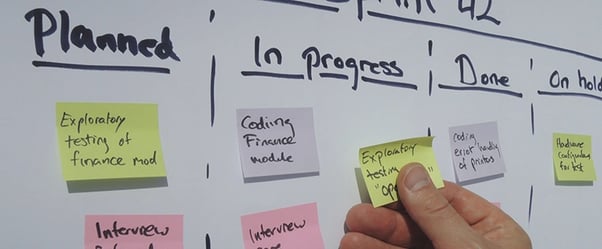
Feature image courtesy of Flickr user alangrlane.
Jami Oetting
Jami Oetting is the Executive Editor of The Agency Post. She is an advertising nerd who's big on creativity, quick wit and good conversation. Interact with her on Twitter @jamioetting or connect on LinkedIn or Google+.